
An SEO content brief is a strategic document that connects keyword research, search intent, and editorial goals before a writer types a single word. A strong one defines primary and secondary keywords, the intended audience, competitor gaps, content structure, and a conversion goal.
Used correctly, it supports the whole content creation process, reduces revisions, improves rankings, and ensures every published post serves both readers and search engines as part of a coherent content strategy.
Table of Contents
- What Is an SEO Content Brief?
- What Does an SEO Content Brief Include?
- SEO Content Brief vs. Content Outline
- Who Uses an SEO Content Brief?
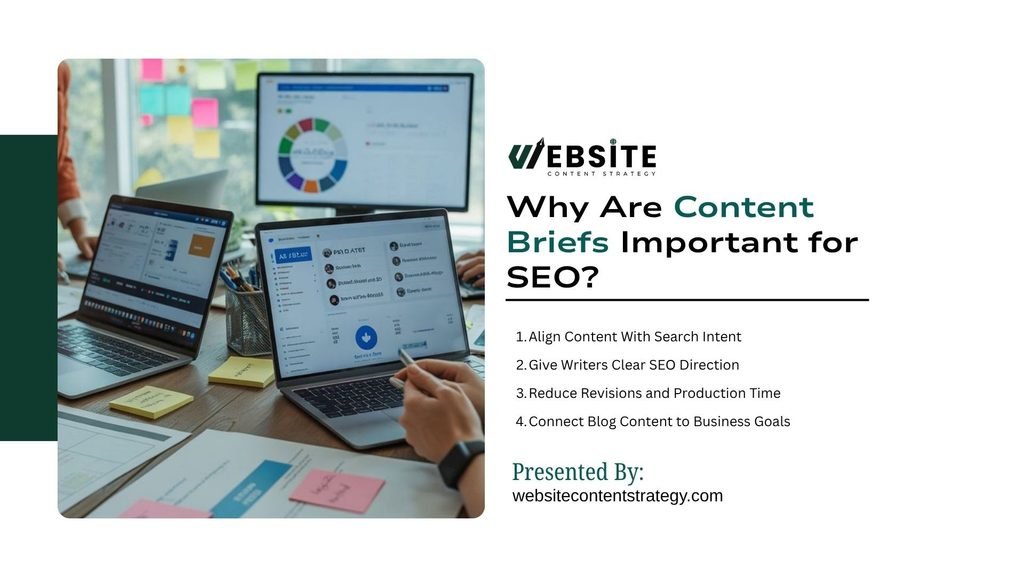
- Why Are Content Briefs Important for SEO?
- Align Content With Search Intent
- Give Writers Clear SEO Direction
- Reduce Revisions and Production Time
- Connect Blog Content to Business Goals
- What Should a Content Brief for SEO Include?
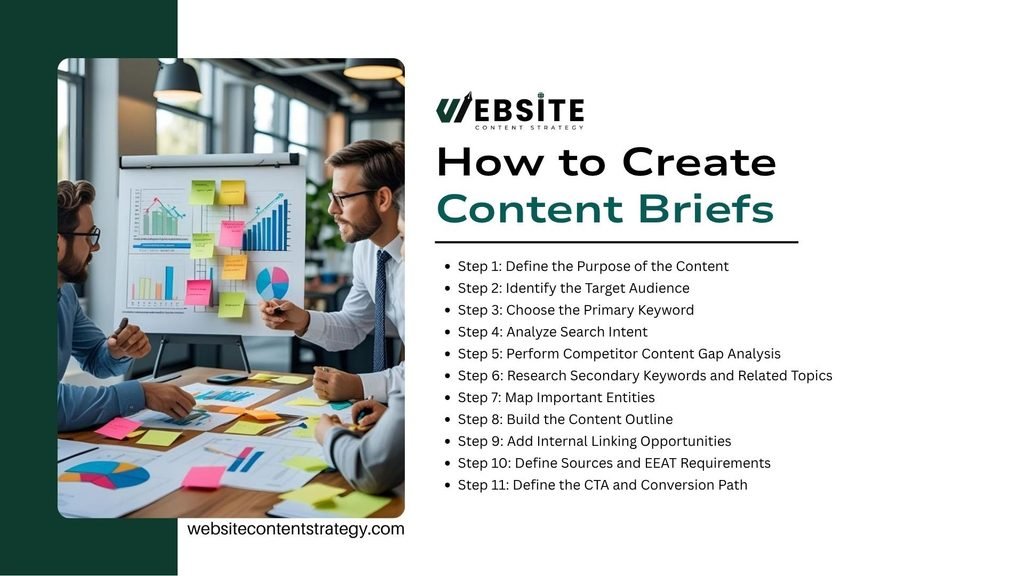
- How to Create Content Briefs for SEO Step by Step
- Step 1: Define the Purpose of the Content
- Step 2: Identify the Target Audience
- Step 3: Choose the Primary Keyword
- Step 4: Analyze Search Intent
- Step 5: Perform Competitor Content Gap Analysis
- Step 6: Research Secondary Keywords and Related Topics
- Step 7: Map Important Entities
- Step 8: Build the Content Outline
- Step 9: Add Internal Linking Opportunities
- Step 10: Define Sources and EEAT Requirements
- Step 11: Define the CTA and Conversion Path
- How to Optimize Content Briefs for AI Search in 2025
- Conclusion
- Frequently Asked Questions
What Is an SEO Content Brief?
An SEO content brief is a strategic document prepared before writing begins. It translates keyword research, SERP analysis, and audience insights into clear instructions a writer can follow to produce a well-optimized, useful blog post, guided by a defined seo strategy rather than guesswork.
The brief sits between research and execution. It is not the finished article. It is not a simple outline. It is the decision-making layer that ensures the content serves the reader’s needs and ranks for the right queries, with a clear main focus the writer can return to at every section.
A brief answers these four questions before the writer starts:
- What is this content about? Topic, angle, and primary keyword.
- Who is it for? The target audience, knowledge level, and buying stage.
- Why does it matter? The business goal, SEO goal, and user intent.
- How should it be built? Structure, links, sources, and tone.
What Does an SEO Content Brief Include?
The most effective briefs cover every key element a writer needs to make smart decisions independently. Leaving gaps forces writers to guess, and guessing creates misaligned, comprehensive content that misses the mark on the page.
A complete SEO content brief should include these key details:
- Target keyword: The main keyword the article must rank for.
- Secondary keywords: Supporting relevant keywords that reinforce subtopics.
- Search intent: Whether the query is informational, commercial intent, transactional, or navigational.
- Target audience: Who the reader is, what they already know, and what they need.
- Content goal: Awareness, traffic, lead generation, or education.
- SERP and competitor insights: Top-ranking pages, content formats, and coverage gaps.
- Recommended structure: H1, H2s, H3s, tables, lists, and FAQ sections.
- Internal and external linking requirements: Anchor text, pillar pages, and authoritative sources.
- EEAT requirements: First-hand experience, expert commentary, and original data.
- CTA: The action the reader should take after reading.
A brief that also sets expectations for writing style and any brand guidelines the writer must follow removes ambiguity before drafting starts.
SEO Content Brief vs. Content Outline
These two documents serve different purposes, and confusing them weakens both.
A content outline lists headings and subheadings. A content brief explains why those headings exist, who they serve, what keywords they should address, and how the section should differ from what competitors already publish.
An outline alone gives writers structure. A brief gives writers strategy.
Who Uses an SEO Content Brief?
Briefs serve the entire content production team, not just writers. Each role uses the brief differently:
- SEO managers use it to enforce keyword and intent alignment.
- Content strategists use it to connect posts to business objectives.
- Content writers use it to understand scope, tone, and evidence requirements.
- Editors use it to evaluate whether the draft delivers what the brief required.
- Subject-matter experts use it to understand where their input adds the most value.
SEO specialists and SEO strategists both rely on the same document to confirm the post satisfies technical SEO requirements before it ever reaches an editor.
Why Are Content Briefs Important for SEO?
Briefs do not just save time. They protect content quality and prevent misaligned work from reaching publication. The business impact is direct.
Align Content With Search Intent
The most common reason a post fails to rank is not weak writing. It is wrong search intent targeting. A writer without a brief may produce a detailed guide when the SERP rewards a comparison page, or write a promotional piece when users want a neutral explanation for the same search term.
A brief defines intent before writing begins, which eliminates this problem.
Give Writers Clear SEO Direction
Writers without SEO experience cannot be expected to know how keyword clustering works, which long-tail keywords belong in H3 subheadings, or which internal pages need links. The brief delivers this information so writers focus on crafting strong sentences rather than performing research mid-draft, protecting their writer craft instead of turning them into researchers.
Reduce Revisions and Production Time
Every revision cycle costs time and money. Most revision cycles happen because expectations were unclear at brief creation. When research, structure, tone, and intent are locked into the brief before writing begins, the first draft lands significantly closer to the published version.
Connect Blog Content to Business Goals
Traffic without conversion serves no one. A strong brief maps the article to a specific stage of the funnel: awareness, consideration, or decision, and specifies the CTA that connects the post to lead generation, email marketing sign-ups, product pages, or further reading that keeps visitors on the site longer.
What Should a Content Brief for SEO Include?
The table below compares the core components of a content brief across five key dimensions. Use it to evaluate whether your current briefs are complete.
| Brief Component | What It Defines | Who Benefits | Common Mistake | Impact if Missing |
| Primary keyword | The main ranking target | Writer, SEO manager | Using broad terms with no ranking potential | Content targets the wrong query |
| Search intent | Informational, commercial, transactional | Writer, strategist | Skipping intent analysis | Wrong content format for the SERP |
| Competitor gaps | Topics rivals miss | Writer, editor | Copying competitor outlines | No differentiation, weak rankings |
| EEAT requirements | Experience, expertise, originality | Writer, editor | Vague instructions | Thin content, low trust signals |
| CTA and conversion goal | Action after reading | Strategist, writer | No CTA defined | Traffic without business value |
How to Create Content Briefs for SEO Step by Step
This is where research becomes action. Follow these steps in order. Skipping steps early creates gaps you will repair during editing at a higher cost.
Step 1: Define the Purpose of the Content
Before choosing a keyword, define three objectives:
- Business objective: What does the company gain from this post?
- SEO objective: Which query should this post rank for?
- Reader objective: What does the reader need to accomplish?
These three objectives must align. If they do not, the brief will send conflicting signals to the writer.
Step 2: Identify the Target Audience
Audience definition shapes every decision in the brief. A post written for a junior marketer and a post written for a seasoned SEO director on the same topic will look completely different.
Define the target audience using these four factors:
- Persona: Role, industry, and experience level.
- Pain points: The specific problem driving the search.
- Knowledge level: What the reader already knows.
- Buying stage: Are they researching, comparing, or ready to act?
Step 3: Choose the Primary Keyword
Keyword research produces a long list of options. Choosing the right primary keyword requires evaluating four criteria:
- Relevance: Does the keyword match the topic accurately?
- Search demand: Does it receive enough monthly searches to justify the effort?
- Business relevance: Does the topic connect to the product or service?
- Ranking potential: Can this site realistically compete for this keyword?
Step 4: Analyze Search Intent
Open Google and search the primary keyword. Examine the top five results carefully. Identifying search intent requires looking at three signals from the top-ranking articles:
- Content format: Are results guides, listicles, product pages, or landing pages?
- Content depth: Are results brief overviews or detailed explanations?
- SERP features: Are there featured snippets, People Also Ask boxes, or video results?
The format the SERP rewards is the format the brief should recommend.
Step 5: Perform Competitor Content Gap Analysis
Gap analysis separates strong briefs from generic ones. Review the top-performing pages and document:
- Topics every competitor covers (these set baseline expectations).
- Topics no competitor covers (these become your differentiation opportunities).
- Outdated statistics or recommendations competitors have not updated.
- Questions in People Also Ask that no competitor answers directly.
These findings translate into specific instructions for the writer. “Cover X because no competitor explains it clearly” is far more useful than “be thorough,” and it turns generic advice into key points the writer can act on immediately.
Step 6: Research Secondary Keywords and Related Topics
Secondary keywords, long-tail keywords, and semantic keywords help the article cover a topic completely without forcing the same phrase into every paragraph.
Use tools like Ahrefs, Semrush, or Google Search Console to identify:
- Keyword variations that share the same intent.
- Long-tail queries that belong in H3 subheadings.
- Related questions from People Also Ask and autocomplete.
- Semantic keywords that signal topical authority to search engines.
A well-built keyword list at this stage prevents the writer from repeating a single keyword so often that it confuses readers instead of helping them.
Step 7: Map Important Entities
Search engines do not just read keywords—they recognize entities. An entity is any named person, product, organization, process, or concept relevant to the topic.
Map entities for the brief in the following categories:
- Primary entity: The main subject of the article.
- Related entities: Tools, concepts, or organizations the article should reference.
- Supporting concepts: Processes, frameworks, or definitions the reader needs.
Step 8: Build the Content Outline
Turn all research into a structured outline, ideally starting from a reusable SEO content brief template or a basic content brief template so the format stays consistent across writers. Every H2 should address a major user need. Every H3 should answer a specific supporting question. The brief should specify:
- H1: The exact or near-exact title.
- H2s: Major sections based on user needs, not competitor headings.
- H3s: Supporting questions that add depth.
- Structural elements: Where tables, examples, and checklists belong.
Step 9: Add Internal Linking Opportunities
Internal links support keyword clustering and help search engines understand how pages on a site relate to each other. The brief should specify:
- Pillar pages this article should link to.
- Cluster articles that should receive links from this post.
- Anchor text suggestions that match the target keyword of the linked page.
Step 10: Define Sources and EEAT Requirements
Strong EEAT signals require more than good writing. The brief must tell writers exactly what kind of evidence to include, along with any technical details like required meta tags or accessibility notes for screen readers:
- First-hand experience: Real examples from practice.
- Expert sources: Named professionals, researchers, or organizations.
- Original data: Proprietary insights, case studies, or test results.
- Authoritative external sources: Government sources, research papers, or industry publications.
Step 11: Define the CTA and Conversion Path
Every piece of content serves a purpose beyond ranking. Specify the action the reader should take after finishing the article—whether that means downloading a resource, starting a free trial, booking a consultation, or reading a related post.
How to Optimize Content Briefs for AI Search in 2025
AI-powered search results now surface alongside traditional blue links. Content briefs must account for Answer Engine Optimization (AEO) and Generative Engine Optimization (GEO) if the goal is visibility across Google AI Overviews, ChatGPT, Gemini, and Perplexity.
Build these requirements into every brief:
- Direct answer sections: Instruct writers to answer the main question within the first 100 words.
- Question-based H2s and H3s: Phrase headings as the questions users actually ask.
- Entity-rich language: Name tools, concepts, and sources explicitly rather than using vague references.
- Citable statements: Write specific, verifiable claims that AI tools can extract and attribute.
- Information gain: Include at least one original insight, example, or framework that competing pages do not provide.
AI tools can accelerate research by organizing SERP summaries, clustering related questions, and drafting initial outlines. Human judgment must govern intent analysis, gap prioritization, and EEAT requirements.
Conclusion
An effective content brief for SEO is the strategic bridge between keyword research, search intent analysis, competitor research, and high-quality writing. Without it, even skilled writers produce content that misses the mark—targeting the wrong audience, covering the wrong topics, or failing to connect traffic to business results.
Start by defining the purpose, target audience, and primary keyword. Layer in secondary keywords, semantic keywords, and competitor gap findings. Build a structured outline that reflects real user needs. Then give writers the EEAT guidance they need to contribute something original.
Briefs do not write the article. They make every article better before writing begins.
Frequently Asked Questions
What is an SEO content brief?
An SEO content brief is a strategic document that defines the primary keyword, search intent, target audience, content structure, competitor gaps, internal linking requirements, and EEAT standards for a blog post. It bridges keyword research and content production by giving writers the direction they need to create content that ranks and serves readers.
What should a content brief for SEO include?
A complete brief should include the primary keyword, secondary keywords, search intent classification, target audience definition, content goal, SERP and competitor analysis, recommended H2 and H3 structure, internal and external linking requirements, EEAT evidence requirements, and a defined CTA.
How long should an SEO content brief be?
Brief length depends on content complexity and writer experience. A standard brief for an experienced writer covers one to two pages. A brief for a new writer or a complex technical topic may run three to four pages. The goal is strategic clarity, not a page count. Never pad a brief with instructions the writer already knows.
Can AI create an SEO content brief?
AI tools can accelerate parts of the process: organizing SERP summaries, clustering long-tail keywords, drafting initial outlines, and identifying People Also Ask questions. However, human judgment must govern intent analysis, gap prioritization, source evaluation, and EEAT requirements. AI-generated briefs without expert review often miss nuance and produce generic content.
Do content briefs improve SEO rankings?
Yes, when executed correctly. Content briefs improve rankings by ensuring every post targets the correct search intent, covers relevant subtopics and semantic keywords, differentiates from competitors, and satisfies EEAT signals.